

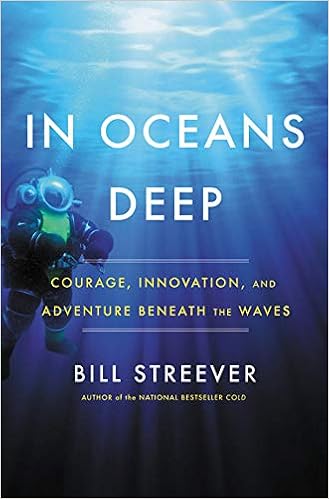
 Bill Streever’s “In Oceans Deep” hits the nail on the head, referencing from the very beginning that the book tackles “humanity’s presence beneath the waves”, and later concluding that “…a key role remains for manned expeditions…inspiration”.
Embodied within those two sentiments is a chronicle of several pivotal moments in human intervention’s history and across various modes of diving – free-diving, manned submersibles, saturation diving, undersea habitation, atmospheric suits, and robotics as human proxies.
Albeit unfortunate, the aquatic world is not full to the brim with writers, particularly those who can convey elements of historical fact through storytelling that is interwoven with personal experience. All too often, diving related books recount an experience, expedition, or some harrowing event – while certainly entertaining, they often miss the broader context that is needed for the non-diver to fully appreciate the material. Streever’s background in commercial diving and marine science helps seamlessly weave together the complex science that separates distinct diving modes, and the writing is fluidly professional. This presentation provides an excellent up to date time capsule for where humanity has been, and where we might be going with our presence beneath the sea.
The book is organized by diving mode, with clear presentations of each’s history, benefits, and limitations which help the reader recognize human limitations, and also the pursuits and motivations that seek to overcome them. Streever goes on to recognize that robotics play a significant role now, and will continue to in the future of human exploration of the ocean. With only a quick glance at the Table of Contents, I was admittedly surprised to see a chapter dedicated to robotic intervention in a book about the role of humans, but found that Streever’s presentation on the subject mirrored my own opinions – in that we should be viewing robotics as extensions of ourselves, not replacements for ourselves. Through this perspective, he preserved the notion that robotics may continue to be used for significant data gathering and other meaningful work, however the inspiration that humans can convey through their personal experiences is really what will keep the diving community moving forward.
Streever also captures a wonderful interview with Sylvia Earle where she states, “…[divers] have the opportunity and the responsibility to share with others”. That interpersonal communication only comes human to human, and emphasizes the need for more people to venture underwater for any number of reasons.
In my own work, I often think about communication strategies including what to share, why, and when to share it. The bottleneck I’ve been discovering is depth of appreciation by a given audience. Yes, most will find various ocean anomalies cool and exciting, but in a time when people digest information in 3-5 second bursts and 140 characters or less, getting past the wow factor and drawing out a deeply legitimate concern and interest for all things ocean is very, very difficult.
The solution? More divers.
More people underwater, means more dinner table talk, means more consideration of how the ocean’s sustenance directly impacts human sustainability, more grassroots action, and more innovation to carry us [Earthly inhabitants] all forward.
Through that effort, remembering context, and not re-venting the wheel is critical. Bill Streever’s “In Oceans Deep” is a great place to start with a baseline of history in human ocean intervention, and well lays out the trajectory that we’ve been on, and should not lose sight of as we move forward towards a new life to, from, and within the sea.
PS- Purchasing the book through the links above benefits our favorite ocean charity, Ocean Opportunity Inc., a 501(c)3 not for profit organization.